
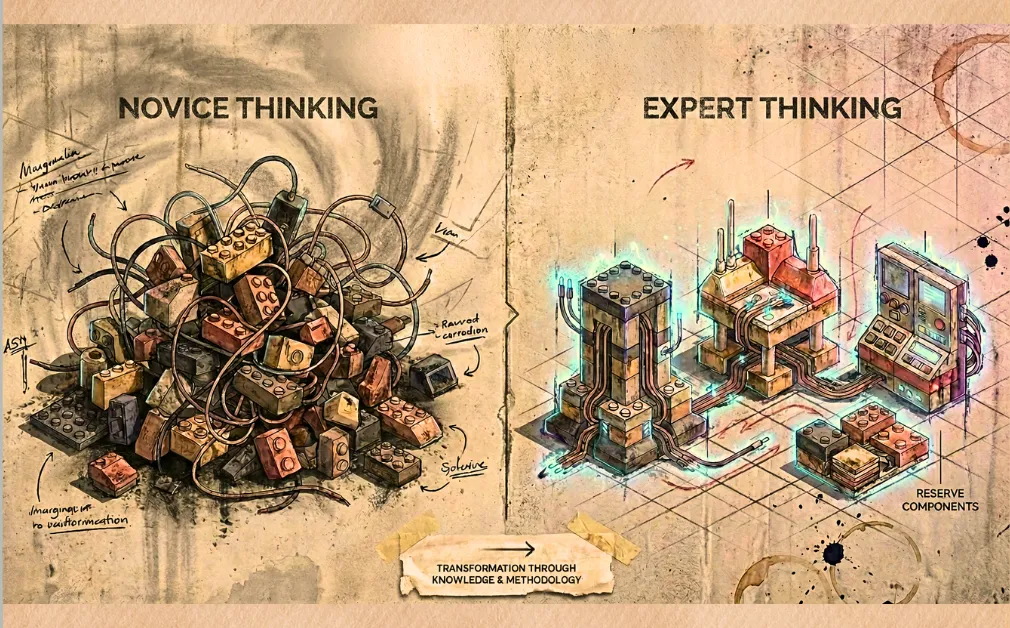
The Guru’s Mastery Fuels Your Chaos: The Unit Economy Problem
As we said in previous articles, your brain is a construction site. It builds mental models.
Learning requires scaffolding—the process of transforming experience into stable memory structures.
Encoding happens when your brain actively:
Differentiates new information from what you already know
Integrates it into existing knowledge frameworks
Practices retrieving it under varied conditions
Watching a video does none of this.
You're not differentiating—you're just absorbing a stream of narrated clicks
You're not integrating—the instructor's mental model isn't yours
You're not practicing retrieval—you're passively consuming
Worse, when you do try to practice immediately after watching, you're not retrieving from memory—you're just mimicking what you saw 30 seconds ago.
True learning happens when you:
Pause
Struggle to remember
Retrieve the information without looking at the source
Apply it in a slightly different context than the tutorial showed
This struggle—this effortful retrieval—is what builds the neural pathways that make knowledge stick.
How Experts Make the Complex Look Simple
Remember how your working memory can only hold 4 chunks? (Here)
Here's the secret: experts have bigger . . . chunks.
Uh . . .
Er . . .
Anyway. when a GoHighLevel expert looks at a workflow, they don't see:
47 individual steps
23 different field mappings
12 conditional triggers
8 integration points
They see: "A lead nurture sequence."
All those details are compressed into a single, familiar pattern—a chunk they've built through hundreds of hours of experience.
That's why they can hold the entire workflow in working memory while explaining it to you. They're not holding 47 items; they're holding 1 integrated concept.
But you, the GHL newbie, don't have the scaffolding for that chunk yet.
So when the guru shows you their feature function tutorial, your brain tries to process it as 47 separate items—and promptly overloads.
What the expert sees in their head is the distilled version of the whole process. They have leveraged what is called Unit Economy. What you see is chaos. (This is the TL;DR explanation.)
*** For the High Performers Amongst Us, here is the long version. ***
Your brain is a ruthless efficiency bigot who lets nothing inside live rent free.
Your brain is constantly performing this cycle.
Step 1: Differentiation (The ruthless part)
The Brain is a picky matchmaker: "I see 200 of these things with flat surfaces with legs?”
“I see 100 shorter things with legs but these are squishy”
Step 2: Measurement Omission (The bigot part)
“Thou art beneath me. I refuse to remember each of the 200 things.”
“I shall reject the individual measurements of these 200 . . . things . . . because I don’t care about individuality. I shall ignore thee. Be gone!”
Alakazam Poof!
200 things become one mental unit: table.
This is how your brain can look at IKEA side table and the finely crafted Amish oak heirloom and say: "Same thing. Details are for peasants."
This is the start of the epistemological show: Unit Economy aka Concepts.
Without concepts, your skull would be a hoarder nightmare—every single table, chair, and existential detail taking up precious mental square footage.
Unit economy is the ultimate cognitive hack: one cheap little concept ("table") houses unlimited real tables for free.
Your brain just went from broke renter to slumlord of infinite real estate. Boom—now you have room for actual thinking instead of drowning in specifics like some cognitive hoarder.
Concepts turn perceptual chaos into a tidy spreadsheet so reason doesn't have a meltdown. Words are just the tiny labels on these mental storage units.
In short: Your brain is too important to remember every measurement. It omits the BS so it can rule the world. Pure, glorious, slightly terrifying efficiency.
*** END Brainy Version. ***
The Guru excels at Unit Economy, you do not.
This is why feature function tutorials break down: The expert says: "Now just set up your lead routing, click, click, click."
In their head, "lead routing" is one chunk encompassing:
Tagging logic based on lead source
Conditional assignment rules
Pipeline stage triggers
Notification workflows
Fallback assignments for overflow
In your head, "lead routing" is 27 confusing decisions you don't know how to make.
The Unity Economy (aka Concept Integration) to Workflow Problem
Skill acquisition isn't about memorizing steps. It's about learning the concepts that underlie the process.
Your brain doesn't store workflows as linear procedures ("Step 1: Click here. Step 2: Enter this."). It stores them as concept specific patterns—built through experience.
Experts recognize patterns instantly:
"This is a cart abandonment scenario → trigger this sequence"
"This is a high-value lead → route to senior sales rep"
"This integration is failing → check these three common points"
They're not thinking through the steps each time. They're recognizing the habituated conceptual framework of “and you can do this, click, click, click.” distilled down to its essentials. They’ve removed the “measurements” e.g., the individual navigation steps so that they can think in a “chunk” and then assemble the “chunks” into the broader workflow.
Here's the problem with video tutorials
You can't build the essential chunks without first going through the concept formation and concept integration process. You can’t build a workflow from someone else's memory.
You build workflow by:
Identifying the essentials
Taking action with the details
Finding the chunks
Assembling the chunks into chains of action.
Failing (No one likes to fail but it is essential)
Getting Feedback
Adjusting
Encountering the same type of situation again (but with variations)
Recognizing: "Oh, this is like that other time"
Repeating until the pattern becomes automatic
This process requires doing, not watching. And it requires encountering the pattern multiple times in varied contexts.
This is how SaaSy Brainformative teaches onboarding. It is tedious and hard -- we know, a terrible marketing message -- but it works.
In a month you will be able to answer the question: "Can the learner actually do the thing 30 days after participating?"
