
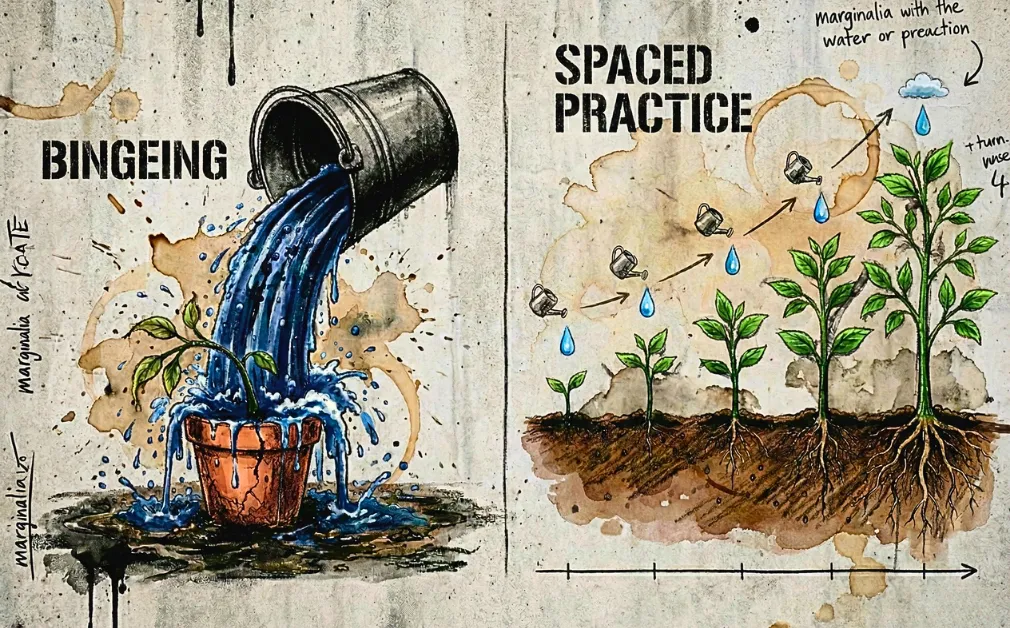
Don't Drown your Brain
When you treat your brain like it's a goldfish on ketamine by day four, your head is a slurry of disconnected mush.
This means that bingeing SaaS feature tutorials is digital self-harm.
The best learning strategies are the ones that ruthlessly leave $h!t out.
By spacing information out over multiple sessions, you give your brain the time it needs to let the seeds of cognition grow.
Memory consolidation doesn't happen while you're mainlining videos. It happens during rest—especially sleep—when your brain replays the important bits, solidifies the connections, and quietly murders the irrelevant garbage.
Binge-watching fails because:
New crap overwrites the old crap before it ever settles.
Your brain never gets the "this matters" memo (no retrieval = no importance stamp).
Everything dissolves into one sad beige fog labeled "I watched some GoHighLevel thing."
What actually works:
Learn one concept.
Practice it.
Sleep on it.
Come back tomorrow and rebuild it from memory (no cheating).
Hit a variation.
Notice what stays the same and what changes.
Lock in the pattern.
It feels slower. It is slower. But it's the only way your energy miser brain encodes knowledge so that knowledge can survive past next Tuesday.
The science of effective learning rests on three pillars. Master them, and you'll learn instead of cosplaying competence.
Pillar 1: Space Your Learning Over Time
Your brain is not a hard drive. It's a moody garden that needs time between waterings—or it'll just drown and sulk.
Distributed practice beats cramming like Ike and Tina.
Every time you return to a subject, your brain is forced to retrieve the material, which is basically doing mental push-ups. Different days, different moods, different contexts—all strengthen the scaffold.
In practice:
Bad: 8-hour "bootcamp" where you learn everything and remember nothing.
Good: 60 - 120 focused minutes a day. Review yesterday's stuff first, then add one new thing.
Implementation:
Nail one concept today.
Practice.
Change subject matter/knowledge domain.
Sleep.
Tomorrow: Retrieve cold, then layer on.
Gradually stretch the gaps (1 day → 3 days → 1 week → 1 month).
Yes, it feels inefficient but only because you’ve lived through 21st century learning methods that started in the 14th century and then merged with assembly line education.
The process we outline is how the brain REALLY learns.
Pillar 2: Embrace Productive Struggle
Here's the part that feels like a prank from the universe: struggling to remember something is the best way to remember it. This is called the testing effect or retrieval practice, and it's effective.
Passive consumption is a liar:
Watch the video → "I'm learning!"
Rewatch it → "I'm a genius!"
Take colored notes → "Look how productive I am!"
All of it is high-quality bullshit.
Real learning starts when you close the tutorial, try to rebuild the workflow from memory, get stuck, curse under your breath, and force your brain to dig.
That frustration bubbling up to when you want to say WTF? That's the signal your neurons are actually building roads.
Why it works:
Retrieval itself strengthens the pathway (even when you fail).
It exposes the illusion of competence.
The feedback from sucking tells you exactly where to focus next.
The next time you are stuck and can’t remember what to do, do this:
Bad: Google it the second you blank.
Good: Sit there like an idiot until you excavate it, then go look for feedback and correction.
Your brain only consolidates when it's forced to work. Passive review is just intellectual foreplay with no payoff.
Pillar 3: Practice Variations, Not Repetitions
Your brain is a pattern-recognition beast, not a parrot. Repeating the exact same example over and over creates brittle, context-dependent knowledge that shatters the moment reality shows up slightly different.
Pro Tip: One video with one example builds nothing. Your brain needs patterns—multiple varied examples, spaced over time, yanked out of memory like teeth.
Pro Tip: Sesame Street had it right:
One of these things is not like the others
One of these things doesn't belong
Can you tell which thing is not like the other
By the time we finish our song?
Varied practice (or interleaving) forces your brain to extract what actually matters versus the decorative fluff.
Why it slaps your brain awake:
Variations make you separate the essential pattern from the accidental details.
Differences highlight the underlying rules.
Mixing related concepts sharpens discrimination.
Practice:
Bad: Build the same landing page five times like a robot.
Good: Build five landing pages exactly the same way. The first one step by step. The second one from memory cheating when you can’t remember. The third from memory with almost no cheating. The fourth totally from memory with one variation. And lastly build the last website but change everything but the structure.
Do this:
Learn the concept with three examples.
Add ONE exception.
Twist the concept into a NEW context.
How to Use All Three Pillars (Without Lying to Yourself)
Everything above demands active construction, not passive consumption. Here's the cheat code:
Context before content
Bad: "Here's how to set up a workflow."
Good: "Your leads are hemorrhaging from three different sources and will ghost you without proper follow-up. Here's how to stop the bleeding."
Concepts before procedures
Bad: "Click here, paste this."
Good: "An API is basically a waiter between two software systems. Here's how GHL takes orders from Zapier."
Sample schedule that works:
Day 1: Learn the concept (with context and mental model), do one example, close the tutorial, rebuild from memory.
Day 2: Retrieve yesterday's cold → hit a variation → sleep.
Day 3: Retrieve both → add another twist → notice the pattern emerging.
Day 4: Repeat.
Day 5: Repeat.
Day 6: Rest.
Day 7: Test yourself on all of them. Can you apply the pattern to something brand new?
It feels slow. It requires actual effort. You can't rage-binge your way through it.
But this is the only method that builds real, transferable knowledge instead of expensive digital clutter in your head.
The Bottom Line
The three pillars:
Space it (distributed practice > cramming)
Struggle productively (retrieval > passive review)
Vary it (patterns > rote repetition)
These aren't cute productivity hacks. They're how human memory actually functions.
The tutorial-binge approach violates all three, which is why you forget everything by next week.
