
But I Watched the Damned Video
“I watch the video but when I go into the platform and try to DO what I learned. I’m lost!”
All right, gather around you, GHL newbies. And you veterans, you can listen in because you are part of the problemo.
(A little Spanish lingo for you.)
Anyway, the YT University “GHL Master Class” guru dropped TED talk-level knowledge bombs and made it seem like 10k a month was just five clicks away.
You could smell the money!
You logged in. Installed the Guru’s freebie and . . . the interface might as well have been written in Babylonian.
WTF!
And then, after you returned for yet another “GHL Master Class” video, the flop sweat builds with every passing hour.
Somehow, you haven’t learned a dang thing!
Newibe, meet your brain. Brain . . . newbie.
(Veterans don’t go anywhere yet)
Newbie, here is the dirty secret your brain won’t tell you. Your brain is lazy AF.
Ok, that isn’t the cognitive neuroscience way to describe it, but it’s the TL;DR explanation.
*** For the High Performers Amongst Us, here is the long version. ***
Your brain is an energy hog—it burns about 20% of your body's total energy (mostly glucose turned into ATP, the cell's battery juice), even though it's only ~2% of your body weight. That's like your NEVAS water cooler sucking up 20% of the electric bill.
And this is just the baseline.
The moment you start thinking about high-level, deep, detailed things - puzzling through systems, building new intellectual scaffolding, troubleshooting SaaS platforms that JUST DON’T play nice in public - your brain clicks over to prefrontal cortex territory—the boss-level executive suite just above your eyebrows.
When you're doing serious mental heavy lifting, the prefrontal cortex lights up and guzzles extra energy. Studies show targeted increases in local glucose metabolism or ATP demand in these areas during demanding cognition, building up glutamate -a sign of metabolic strain - that increases exhaustion.
The prefrontal cortex is metabolically expensive—higher-order thinking racks up serious ATP bills for synaptic signaling, maintaining ion gradients, glutamate recycling, etc.
Your brain treats cognitive effort like a limited resource budget. Why blow extra fuel on deep, effortful processing when a quick-and-dirty shortcut gets you 80% of the way with 20% of the cost?
Passive activities (hearing a clear explanation, rereading familiar text) feel fluent and low-effort → minimal extra energy draw → brain rewards you with that cozy "I get it" dopamine hit.
Real mastery work (self-testing, explaining from scratch, fighting confusion) spikes demand in the prefrontal areas → feels draining → brain screams "AVOID!" to save precious glucose for survival basics (like not face-planting on the way to the dining hall).
Your brain isn’t actually Lazy AF. It’s acting in self preservation using energy-conserving on steroids. Evolution wired your brain as a cognitive miser. This is why it acts like a 15 year old that knows everything but really knows nothing.
*** END Brainy Version. ***
And now you Veterans can get a glimpse at why you are part of the problem.
You enable the Lazy AF newbie brain by insisting that after watching your 10 “Master Class,” Alakazam Poof! Money just appears out of thin air.
Everyone’s Brain Has a Bottleneck
Your brian is a construction site. It builds mental models.
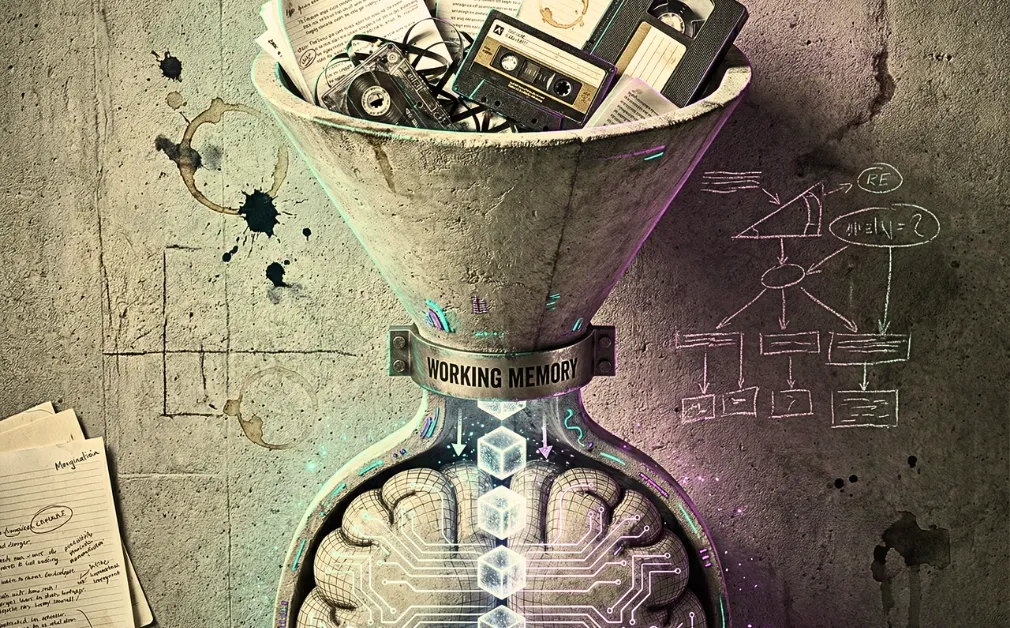
Working memory is the workspace where active thinking happens—where you manipulate information, make decisions, and build understanding.
Here's the problem: that workspace can only hold 4 information "chunks."
(Yes this is the TL;DR summary)
When you watch a GoHighLevel tutorial, your working memory is being flooded:
The first “and you can do this, click, click, click. (1-2 chunk)
The second “and you can do this click, click, click. (3-4 chunks)
Insert caveat click, click, click (5 chunks)
Caveat number 2 Click, click, click (6-7 chunks)
“And oh, I want to make sure that I give you MORE information click, click click!
The brain screams: “STOP TALKING!”
Nothing gets built.
Your brain defaults to passive reception—you experience the video, but you don't process it into usable knowledge. The information never makes it from short-term working memory into long-term storage.
That's why you understand it while watching, but can't reproduce it 10 minutes later.
The Illusion of Competence
Cognitive psychologists call this the fluency illusion.
When information flows smoothly past you (like in a well-produced video), your brain mistakes that smooth flow for understanding.
The instructor makes it look easy. Their platform navigation is confident. Their explanations are polished (because they took 10 takes for the video).
You think: "Oh, I get it. That makes sense."
But "making sense" while watching is not the same as "being able to do it" when the video stops.
Here's the test:
Close the video. Open GoHighLevel. Try to build what you just watched.
Can you?
If you need to re-watch the video to remember the steps, you didn't actually learn it. You recognized it while watching, but you didn't encode it into retrievable memory.
Why the Current Learning Model Is Designed to Fail You
Here is the SaaSy Brainformative caveat. Our current education model started in the 14th century and it hasn’t appreciably changed since.
So, most YT university Guru’s don’t know any better. They are doing Knowledge Transfer the only way they know how. That part is not their fault.
However, the cynical part of our assessment is this: The entire YouTube University / course platform ecosystem is built on metrics that optimize for the wrong outcomes:
Video completion rates → Encourages shorter, flashier content
Course enrollment numbers → Encourages overpromising results
Content volume → Encourages feature dumps, not conceptual depth
None of these metrics measure: "Can the learner actually do the thing 30 days after watching?"
What This Means for Your GoHighLevel Journey
If you want to actually master GoHighLevel (not just feel like you're learning it), you need to:
Stop binge-watching tutorials. Find one concept, work with it. Implement it. Sleep on it. Review it. Refine it. Duplicate it. Sleep on it. Improve it. Duplicate it. THEN find the next concept. .
Close the video and struggle. Force yourself to rebuild what you just watched from memory. The struggle is the point.
Learn concepts, not just clicks. Understand why a workflow is structured a certain way, not just how to replicate it.
Practice with variation. Don't just copy examples—adapt them to your own use cases.
Expect effort. If it feels easy while you're learning it, you're probably not learning it. Difficulty means encoding is happening.
Space your practice. Deliberate practice over weeks beats cramming over weekends.
The Bottom Line
Your brain is not a video recorder. It's a pattern-recognition engine that requires:
Effortful encoding (not passive watching)
Varied practice (not identical repetition)
Spaced retrieval (not binge-learning)
Conceptual frameworks (not step-by-step mimicry)
The current SaaS learning model ignores all of this.
We don't.
