
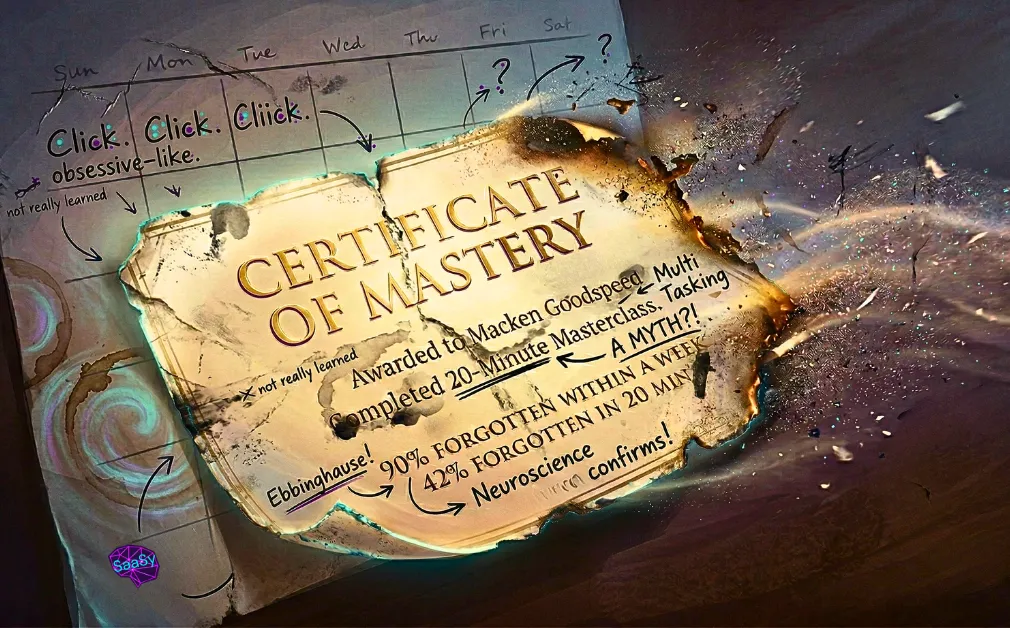
Why 20-Minute Masterclasses Fail to Teach Mastery
"Master complex workflows in 20 minutes!"
"Learn advanced analytics over lunch!"
"Get certified this weekend!"
It’s great marketing, but it’s totally untrue.
This Article Covers
We'll examine 6 of the 35 brain principles that govern how humans learn:
Why 20-minute masterclasses violate cognitive architecture
What the 6 Cognitive Capacity Management principles are
How the SaaSy Brainformative Insight Cohort model respects each principle
By the end, you'll understand why most training is structurally impossible to retain—and what to do instead.
As we said, it's great marketing but totally untrue. Well, let us amend, theoretically, you can get a certification in a weekend, but so what?
If people are merely trying to stuff a resume, that is fine; that detail might get the interview, but when they ask about actual knowledge, it will be apparent that the candidate doesn’t really know anything.
Here is the memory reality:
42% of content is forgotten within 20 minutes
70% forgotten within 24 hours
90% forgotten within a week
Think of it this way, Grand Umpty Ump SaaS internet Guru has posted the master class of a lifetime. He reviews his analytics as they spike through the Ethernet roof. He’s confident that his training has changed his SaaSprenure mastermind community. Certainly, everyone will immediately begin to take action on his directives. The comment section fills up with thunderous applause.
A week later, nothing has changed. He gets the same questions, the same confusion, the same demands for hands-on support.
“WTF?!” he rants to his AI assistant, “Did they not hear me?”
And if that AI assistant knew anything about brain science, they would say, “They heard you, but within 20 minutes, they forgot 40% of what you said. By the next morning, they might remember a few pithy lines. By Friday, they might remember that you spoke on Monday.”
Ebbinghaus Forgetting Curve
Hermann Ebbinghaus documented this phenomenon in 1885. His findings have been replicated in hundreds of subsequent studies. The decay rates are consistent across content types, learner populations, and contexts.
But more important than any academic study is your personal experience. You watch the masterclass, and you may have taken notes, yet, within a week, you can barely remember the name of the video or where you put your notes.
You are trained to believe this is a personal failure.
It is not.
The brain’s superpower is its ability to delete. It is bombarded with billions of data points every day. It cannot retain everything, so it prunes with impunity. Until the brain realizes that specific knowledge is important, it assumes that knowledge is cognitive waste.
The neural truth: Your brain physically cannot consolidate complex learning in a single session because it has no way to measure the value of that content from one exposure.
Memory formation requires:
Days to Weeks for neural trace stabilization—synaptic connections strengthened through protein synthesis
Distributed practice across time produces 200-300% better long-term retention than massed practice
Active retrieval that forces reconstruction, creating stronger memory traces than passive review
Sleep-dependent consolidation that transfers hippocampal memories to the neocortex for stable storage
A 20-minute masterclasses violate all four mechanisms.
This isn't a pedagogical preference. Or said another way, this isn’t everyone has “different learning styles.” This is a description of brain architecture.
The Foundation of Brain Architecture
Cognitive Capacity Management: The brain's hard processing limit — AKA the gatekeepers.
The human brain, much like an AI's limited context window, can only process about four chunks of information at a time. The prefrontal cortex further restricts processing based on how information is presented: as images, sounds, or both.
Pause reading and take a quick mental inventory of the sounds around you. How many of those sounds did you NOT hear merely seconds ago?
Your brain throttles sensory input so the prefrontal cortex can perform the complex action of reading: turning images into concepts, then conceptual integrations, and finally placing them into stored knowledge blueprints (Schema). This process isn’t a soft guideline. This is the hard limit imposed by the neural architecture.
Let’s step into the neuroscience weeds.
Brainformative has identified 6 brain principles that govern capacity:
Cognitive Load Theory:
Total cognitive load = intrinsic load (inherent difficulty) + extraneous load (poor design) + germane load (productive schema-building effort).
When the total load exceeds capacity, learning fails.
Attentional Bottleneck: (Structural Constraint)
The prefrontal cortex's executive function is limited by a single high-level control channel. This means you can only sustain one complex goal state in active processing at any given moment. There's one conductor coordinating cognitive operations.
What it governs:
Goal maintenance ("What am I trying to accomplish right now?")
Task-set configuration ("What rules/procedures apply to this task?")
Strategic control ("What should I attend to? What should I inhibit?")
Chunking: (Structural Constraint)
Information must be organized into 3-4 meaningful units to align with working memory limits.
Modality Principle: (Structural Constraint)
Distributing information across verbal (auditory/linguistic) and visual (spatial/pictorial) channels prevents overload of either pathway.
Multitasking Myth: (Behavioral Phenomenon)
Despite the belief in efficient simultaneous multitasking, humans are actually rapidly task-switching, which incurs measurable attention costs.
Self-proclaimed great multitaskers are actually less productive, make more errors, and experience cognitive exhaustion.
Pre-training Effect: (Behavioral Phenomenon)
Introducing key concepts before the main instruction reduces cognitive load during complex learning tasks.
Pop Quiz: You've now seen the 6 principles. Grab a Post-It note and answer this:
Which principle explains why you can't listen and read simultaneously?
Which one explains why webinar chat destroys learning?
[Look away from the article and write it down. Trust us, writing improves retention.]
Now, let's delve deeper into the cognitive intricacies to explore what might seem like a subtle, yet important, distinction: the Attention Bottleneck versus the Multitasking Myth. They aren't synonyms, but these interconnected cognitive phenomena explain why divided attention degrades learning.
The Attentional Bottleneck is a fundamental structural constraint: the prefrontal cortex can only manage one high-level goal state at a time. When a learning environment demands simultaneous management of multiple complex goals, it exceeds the learner's capacity, creating "cognitive gridlock" and making goal maintenance impossible.
The Multitasking Myth stems from the brain's fundamental structural limit.
Since simultaneous processing is impossible, learners rapidly task-switch. This constant alternation forces the brain to repeatedly undo and rebuild mental schemata (models) for each new context. Though fast, this perpetual rebuilding is where errors proliferate, and cognitive fatigue builds.
Multitasking's worst failure is training the brain to find nothing important, undermining the Attention Bottleneck. If nothing is deemed important, the brain directs its energy to... nothing. And people wonder why they have a problem focusing?
The Bottom Line
Capacity management is foundational to all learning, governing every moment of cognitive processing. The attentional bottleneck can be violated during both instruction and retrieval practice. Ignoring these constraints overloads the system, and people abandon learning.
Comparison and Contrast
YouTube/Webinar Video Starts: “Here is my masterclass on a super sexy new SaaS platform that will change the world. I will show you how to get set up in 20 minutes so you can make 10K a month.
So you can do this: click click click.
And then you need to set up this thingamajig: click click click.
Oh, and now you need to get these settings from this other platform: click, click, click.
And I forgot to tell you about these features here: click, click, click.
Now you will need your logo and branding, so go to this website to create them: click, click, click.”
And so it goes, and goes and goes and goes . . . until the host offers the sales pitch to join the Skool mastermind, where you can take “massive action” and receive “accountability.”
Now, let's break down the video tutorial in light of the 6 brain principles.
Here is what the presentation demanded.
Task A: Watch the instructor's screen and track the tiny mouse cursor (Visual Channel)
Task B: Hear the instructor's narration. (Auditory Channel)
Task C: Read menus (Orthographic Processing)
Task D: Perform actions in your own software (motor control + executive function + visual attention + working memory)
Task E: Exit video to the interface being learned and to third platforms. (Context Switching)
Task F: Replicate multiple sequences (chunk together linear actions to an outcome)
Task G: Identify a caveat (reframe your new mental models with an additional change)
Now you can understand why it is so challenging to learn from video libraries. Tasks A and B are functionally impossible; your brain must choose one.
You must choose to watch or listen, assuming you can see the cursor. Often, you cannot, as modern training videos prioritize "production value," leading to rapid zooming, stylized cuts, and the constant cursor "happy dance" as the guru tries to emphasize a point.
And then, when Task C also requires the learner to read, the channels are overloaded by orders of magnitude.
Here is what’s happening when you read: your brain transforms visual symbols (letters, graphemes) into linguistic meaning.
This involves multiple neural systems working in concert: Visual Analysis → Orthographic Recognition → Phonological Assembly → Lexical Access → Semantic Retrieval
Unlike simply "seeing shapes," reading requires:
Sequential processing: Letters must be decoded in order (left-to-right in English)
Phonological activation: Even silent reading activates speech production areas (Broca's area)
Working memory load: Holding decoded words while processing subsequent words to extract sentence meaning
Lexical retrieval: Accessing word meanings from long-term memory
Syntactic parsing: Determining grammatical relationships
Reading text while listening to narration interferes with learning because both use overlapping neural resources (phonological loop, semantic processing, working memory).
When a webinar leader asks the audience to type a "YES!" in the chat, it's disastrous for engagement. The audience cannot hear, read, and type simultaneously, which is why the leader gets exasperated when no one hears the next point.
Task D (platform actions) requires stopping/starting a video. Live broadcasts make "following along" impossible.
Context switching, like in Task E, forces the brain to dismantle existing learning structures and build new ones for the second topic. This is a learning disaster because returning to the original content is now exponentially harder for the novice because their mental models are nearly nonexistent.
Task F (Feature function Click, Click, Click) is a violation of the Chunking principle.
Let us explain what we mean by a common feature function from very well-known software.
Since Office 95, people have made text bold, italic, and underlined without thought. Yet, the process is surprisingly complex.
Highlight the word you want to apply formatting to. (click)
In your menus, find format (click)
Find Text (click)
Find Bold (click)
And this process assumes that the formatting dialogue isn’t showing, or that you know how to highlight a word with the mouse, or that you know what a menu is.
This workflow seems obvious in 2026, but some of us at SaaSy Brainformative are old enough to remember when this process was new. We are old enough to remember teaching people how to use a mouse by playing solitaire because our students did not understand click and drag.
This isn't a nostalgia trip; it's an attempt to clarify the underlying conceptual steps needed for a basic feature to work. Over time, and with repeated exposure, people have mentally 'chunked' the necessary steps into a single, automatic process. However, every time a "Master Class Guru" says, "And you can do this, click, click, click," they are fundamentally disregarding the 'chunking' principle.
Software tutors that stack processes, feature functions on feature functions, overwhelm learners with too many details, violating the Chunking principle; your inability to remember is not your fault.
Avoid the "Expert's Curse": Group Caveats and Addenda into a Dedicated Task
Feature function tutorials frequently fall victim to a significant teaching violation: scattering caveats and addenda throughout the main workflow. This is why we created Task G (Caveats and addenda).
In typical training, a user follows along as the trainer—an expert—demonstrates a process. Just a few clicks in, the expert abruptly interjects with deviations like, "But you might want to do this," "And you might want to do that," or, "Oh, I forgot to tell you about this addendum."
This fragmented teaching style is a classic symptom of the "Expert's Curse." Experts possess sophisticated mental models that easily integrate variables and subtleties, making additional context feel relevant and necessary to them. Crucially, however, they overlook the significant cognitive load these detours impose on a novice. The beginner is left struggling to manage a constant stream of exceptions and deviations.
More profoundly, in our view, the inclusion of caveats and addenda betrays a severe lack of preparation. It is often glaringly obvious that most feature function tutorials are simply individuals improvising on camera. They've run the process countless times, making it seem simple and obvious to just start recording and talking. Yet, they have fundamentally failed to consider their audience. They are prepared to broadcast information, not to prepare their audience to learn it.
To inject caveats and addenda into any training is nothing less than a cognitive capacity management deathblow.
Why Small Groups Aren't a Nice-to-Have
Most training companies offer cohorts for "engagement" or "accountability."
That's not why SaaSy Brainformative does it.
First, we are not here to babysit. Small business owners and entrepreneurs must be engaged and accountable for achieving their goals; they either have the motivation to act, or they don't. That is their choice, not our job.
Second, accountability requires the ability to impose consequences—the ability to bring force. While trainers and SaaS gurus mean well, they lack the necessary force to deliver consequences. Their accountability offer is structurally impossible.
Third, we offer cohorts because small groups are the only way to respect Cognitive Capacity Management.
The SaaSy Brainformative Insight Cohort
Task A: SaaSy Brainformative Insight Cohorts begin the moment you enroll.
After your receipt is delivered to your primary business email, you will shortly receive three follow-up emails focused on proper email communication: delivery best practices, setting expectations, and general etiquette. This series establishes the essential groundwork for effective communication. We focus on delivering content is essential for your cohort's achievement. Signing up will not result in a flood of marketing upsells and add-ons.
Task B: Once the administrative tasks are complete, your initial assignment will be to establish your knowledge management system. This involves setting up a dedicated space for your resources and learning materials. We will provide a recommended folder structure to help you manage this data effectively.
Task C: 24 to 48 hours later (enough time to perform the previous exercise), an email will provide best practices for establishing a self-directed learning schedule.
Task D: You will receive your login credentials. (We know that people assume account credentials should be first, but we will explain the learning logic momentarily.)
Task E: You will start the self-directed exercises in accordance with your pre-planned schedule.
You are a professional and the master of your own time. Focus on thoroughly completing all exercises, even those seemingly unrelated to the Gohighlevel platform or setting up your Minimum Viable System. Rushing won't gain you any advantage.
As a professional and the master of your schedule, commit to completing every exercise, even the tasks that may not immediately seem related to completing your Minimum Viable System. Remember, taking your time and being meticulous is more beneficial than rushing.
We expect a high commitment to completion. Although we don't act as babysitters, we track your progress and audit homework. You must achieve a 95% completion rate to be eligible for the live cohort. Once we reach our target cohort size, invitations for the in-person cohort sign-up will be distributed.
Once the cohort is filled, we will introduce you to your colleagues. This is an outstanding opportunity to ask questions amongst yourselves (not a time to solicit business)
Task F: 2 days before the cohort, you will receive one last homework assignment, the answer to which you will be asked: “Come prepared to discuss . . .”
Task G: The day of the cohort, you log in and see
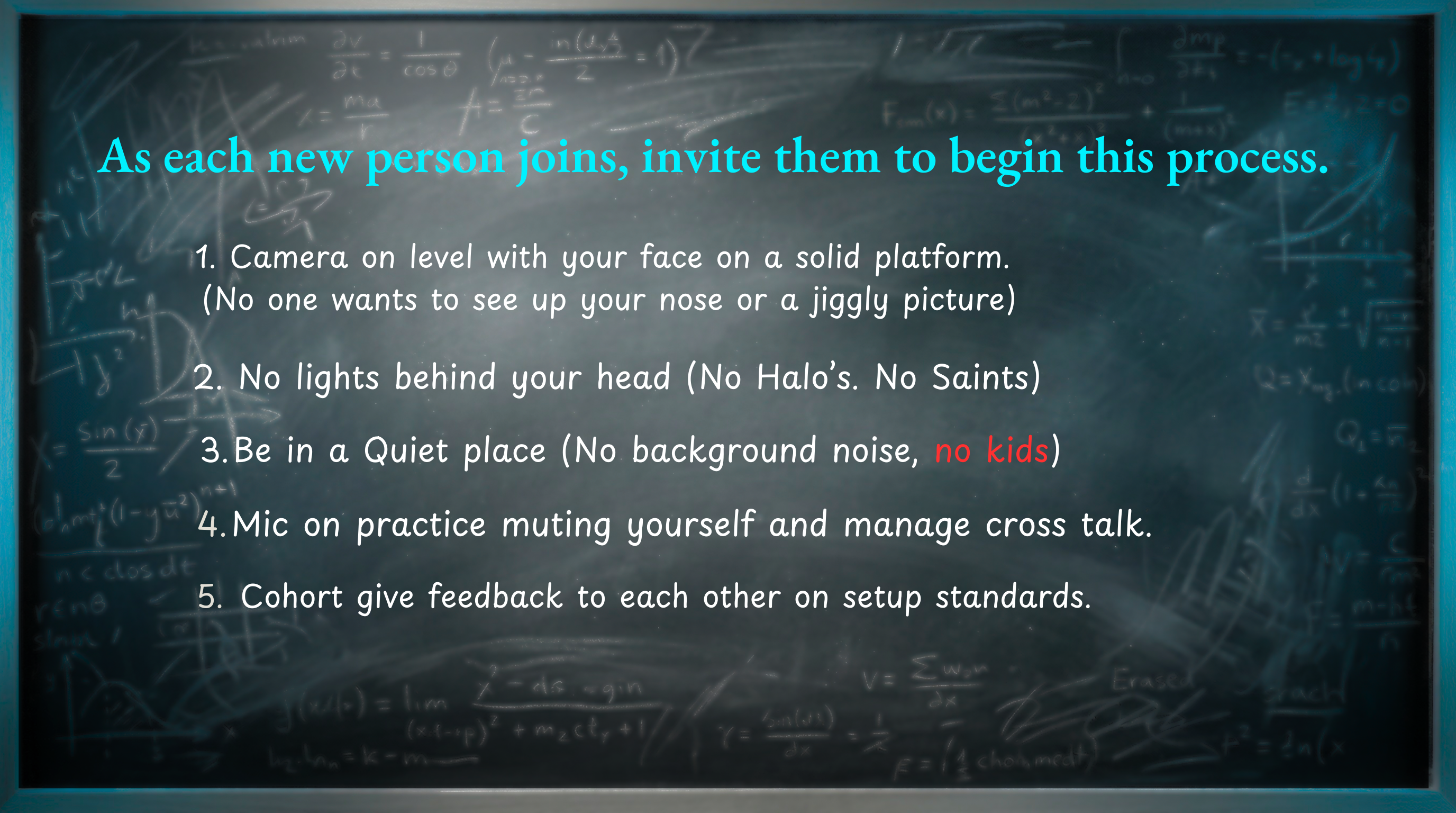
Task H: The facilitator arrives and, without much preamble, says: “Steve, you are prepared to discuss . . . “
And so the cohort training continues, the facilitator asking and directing the conversation around the core topics, hearing challenges, asking for others to explain solutions, and identifying errors.
The cohort will last roughly 2.5 hours.
Now we will unravel the brain science behind the design
The complete learning evolution is too detailed to follow, so we will pause our description here. What we have shared sufficiently highlights the distinctions between this brain science approach and the typical online master class.
Task A: Confirms the technical foundations of communication. This limits cognitive resources to the specific task (germane cognitive load) and surfaces foundational barriers to the outcome (eliminates extraneous cognitive load)
Task B: setting up knowledge management.
How many times have you thought, “Where did I download that PDF? Where did I put my notes for this webinar? Didn’t they give me some resources? I need to log back into the course and find that stuff. Wait, what module was that again? Shit, I need to watch all these videos again to remember what they said.”
This represents an enormous amount of cognitive friction, touching nearly all of the Cognitive Capacity Management principles, but it directly impacts Cognitive Load, the Attention Bottleneck, Multitasking Myth.
Humans find it hard to make decisions about taxonomy, or in other words, to establish and maintain a system for capturing and utilizing knowledge. As a rule, if it takes people more than 10 seconds to capture something: a resource, idea, etc., it is abandoned.
Managing knowledge engages the prefrontal cortex. It requires making lots of interconnected decisions that derail learning at the moment of... learning. This exercise is a crucial step to keep our learners on track and on task.
Task C: You have seen behind the curtain, so some of you will be tempted to jump ahead and try Task B with Task C. That is fine, but the goal is to focus on ONE outcome. We separate these two actions because both have a deceiving number of decisions, and decision fatigue is very real. The time between both tasks allows your brain to simmer and rest.
Task D: Credentials and Account login. We acknowledge above that it seems like this should come first because “this is what I paid for.” Well, since most people are habituated to thinking they paid for a video library that they are excited to watch, this assumption is understandable. But that is not this.
We cannot emphasize this enough. You are not paying for a video library. Go watch YouTube if that is your objective. This cohort structure is unique in the training industry. As we said above, your participation in the cohort started when you obtained your receipt.
Statistics, facts, and figures are tedious to read, but the drop-off rates between getting credentials, accessing content, and watching the first 10 videos, and then subsequently never logging into the account again are demoralizing for content creators. People are excited to get started. We understand. But “getting started” here isn’t watching videos. You get started doing one homework assignment at a time.
This is how you train your brain to pay attention to the important things: This is the positive side of Attention Bottleneck.
Task E: Self-directed learning means you're in control. While you could quickly go through all the videos and reading materials in a few hours, we guarantee you won't gain anything if that's all you do. The exercises are specifically designed to engage your meta-cognition—thinking about thinking. This is crucial for building memory structures and retaining information, though it's distinct from cognitive capacity management. We will ask you to draw, take photos of your creations, and upload them to the group. You'll also answer questions and then rank your confidence in those answers on a 1-5 scale: 1 means you're taking a "Wild Ass Guess" (WAG), and 5 means you're operating with absolute certainty ("Coming off Mount Sinai").
Do the work, and you won’t be sorry.
Task F: “Come Prepared to discuss ... “ This is the Pretraining Effect in action. You are priming your brain to focus on important things.
Task G: Far too much training time is wasted on preamble: Introductions, Credential recitals, and awkward segues. Far too much brain power is wasted on shoutouts and inane chat comments. Webinar time is wasted when participants lack the basic skills to display their screen or manage their microphone (muting and unmuting).
Our introductory instructions circumvent this loss.
The self-directed group exercise is designed to focus participants on the goal of learning. The instructions orient everyone toward what is important by initiating being both student and teacher.
In a SaaSy Brainformative Cohort, there is no hiding. There is no lurking. There is no being too cool for school. You will be on the spot to participate. This is where the profound power of “the one teaching is the one learning” begins to shine.
Task G: Sub Note. Speaking of wasted time. If you come late, don’t ask, “What did I miss?” Know that you missed a lot, and more importantly, your colleagues missed the opportunity to learn from your mental models. And, the cohort is not remedial time. You need to have done the work before you get there. We will not be reviewing content to get participants up to speed. Show up at speed.
Task H: When the facilitator asks “Steve, you were prepared to discuss...” they are putting the fine point on the learning. It is in this moment that everyone begins to see how others think, how others process, and what fits best in their mental models.
Why do our engagements last 2.5 hours?
After delivering thousands of training hours, we’ve identified this learning sweet spot. Much less, and we lose the ability to cover concepts in any depth. Much longer, and people are exhausted.
Pro Tip: You will be tired, but after about 3 hours of recovery time, you will have an avalanche of insights. Have your voice recorder/note-taking tools close at hand.
We Know We are Different
Let's be honest about what you're really buying when you sign up for a masterclass:
✅ The feeling of productivity
✅ The appearance of professional development
✅ The permission to check "learned new skill" off your list
What you're not getting:
❌ Actual competence
❌ Retained knowledge
❌ Transferable skill
And here's the part that should bother you:
Every hour you spend on learning that doesn't stick is an hour you can't get back.
You're wasting more than just money on those courses—you're squandering your brain's precious capacity for consolidation. You're training yourself to forget. You're building the habit of shallow engagement.
The SaaSy Brainformative Insight Cohort isn't sexy. It won't let you "master" anything in 20 minutes. It requires homework, participation, and cognitive effort.
But six months from now, you'll still know it.
You'll be building.
The brain science is clear. The choice is yours.
