The Dirty Little SaaS Secret
Starting a Free Trial is NOT Starting A Business
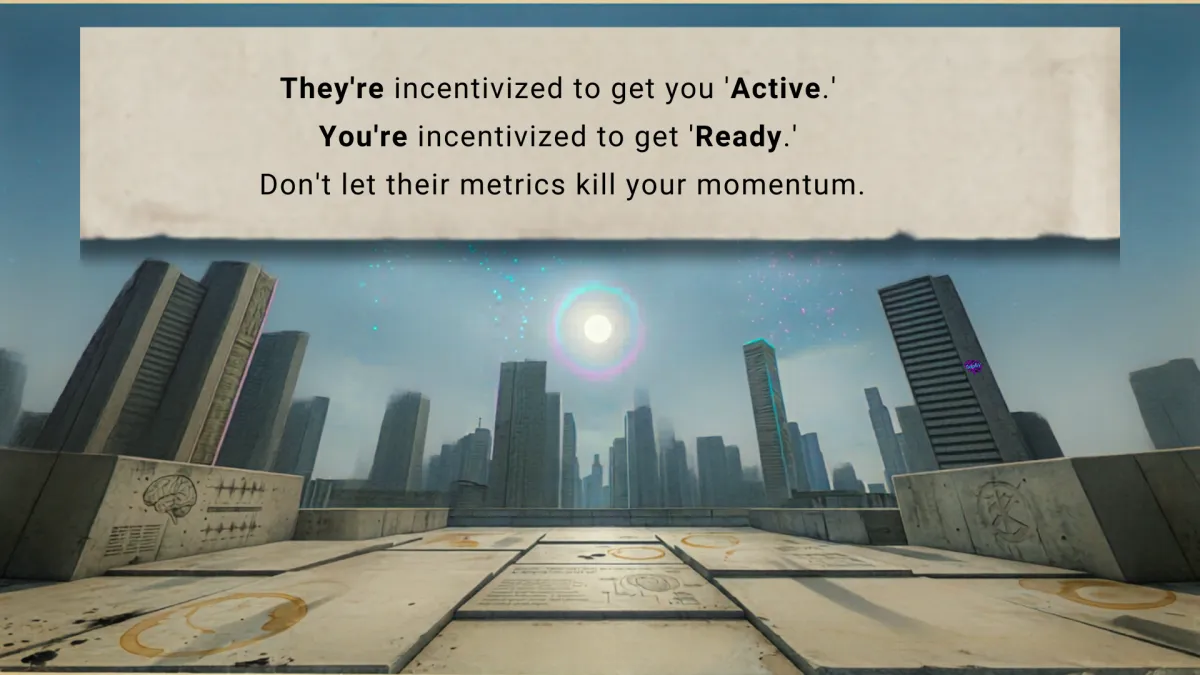
SaaS onboarding is designed for their business model. They optimize for headcount.
As A Solopreneur, you must optimize for foundation.
When the foundations are unfinished, you pay the "SaaS Tax"—hundreds of dollars a month for a powerful engine with no wheels.
Build your foundation first. Launch your tech last.
The Setup Black Hole
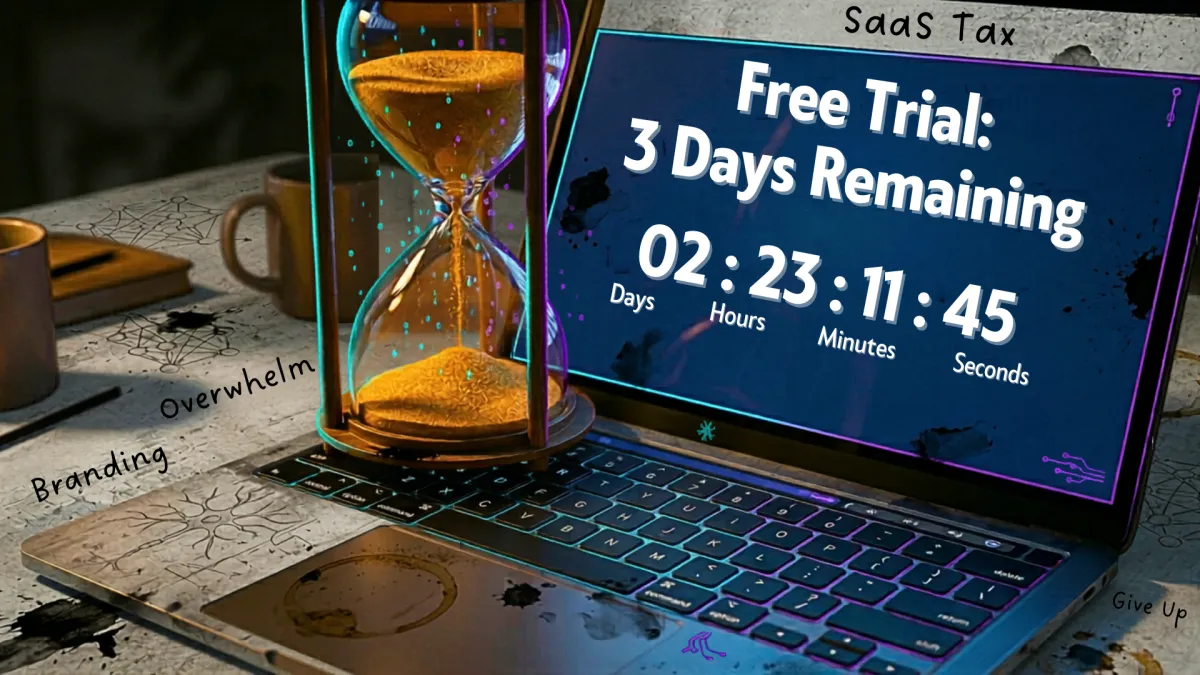
You started “onboarding.”
You hit a wall: Branding.
You spent 10 days wrestling with Canva before looking for a Fiverr designer.
They asked you 20 questions, and you only had muddled answers.
Now you wait.
You can’t create an offer without a business bank account.
You can’t get the bank account without an EIN.
The free trial clock expired. The platform started charging $299 a month.
The Missing Foundation
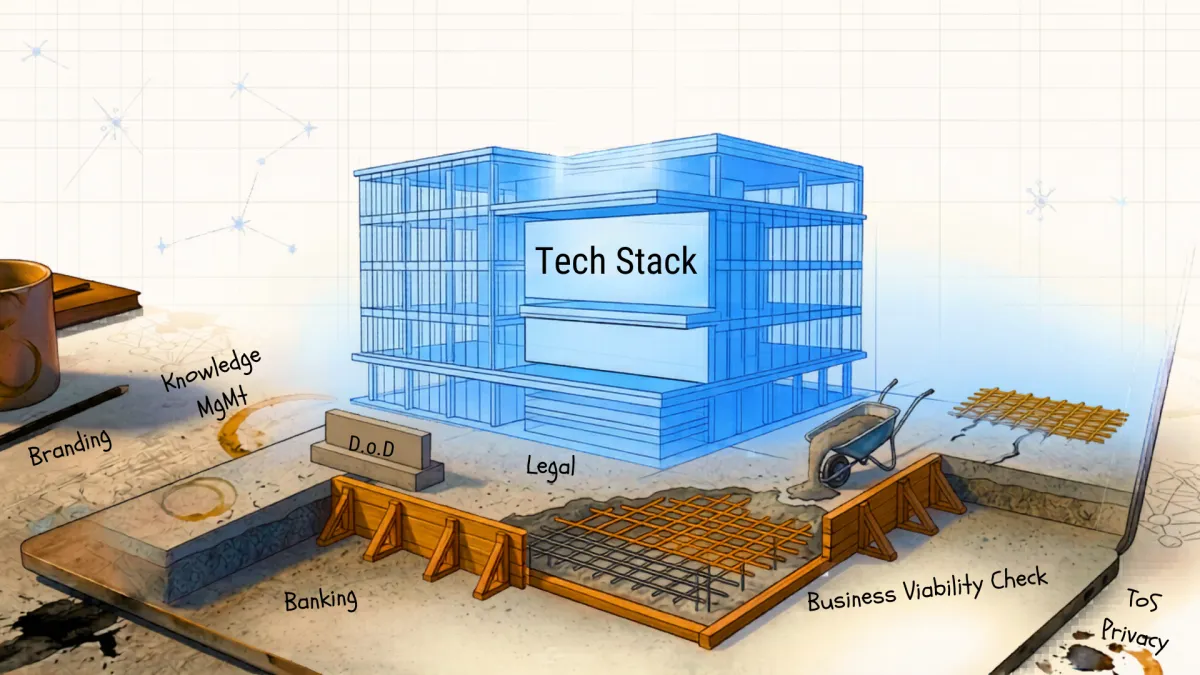
The Solopreneur’s Launchpad Hub is the foundation the giants can't afford to build.
We've mapped the real startup sequence—the legal, financial, and strategic work that has to happen before the SaaS clock starts ticking.
We don't replace the platforms.
We make you ready for them.
The Solopreneur’s Plan
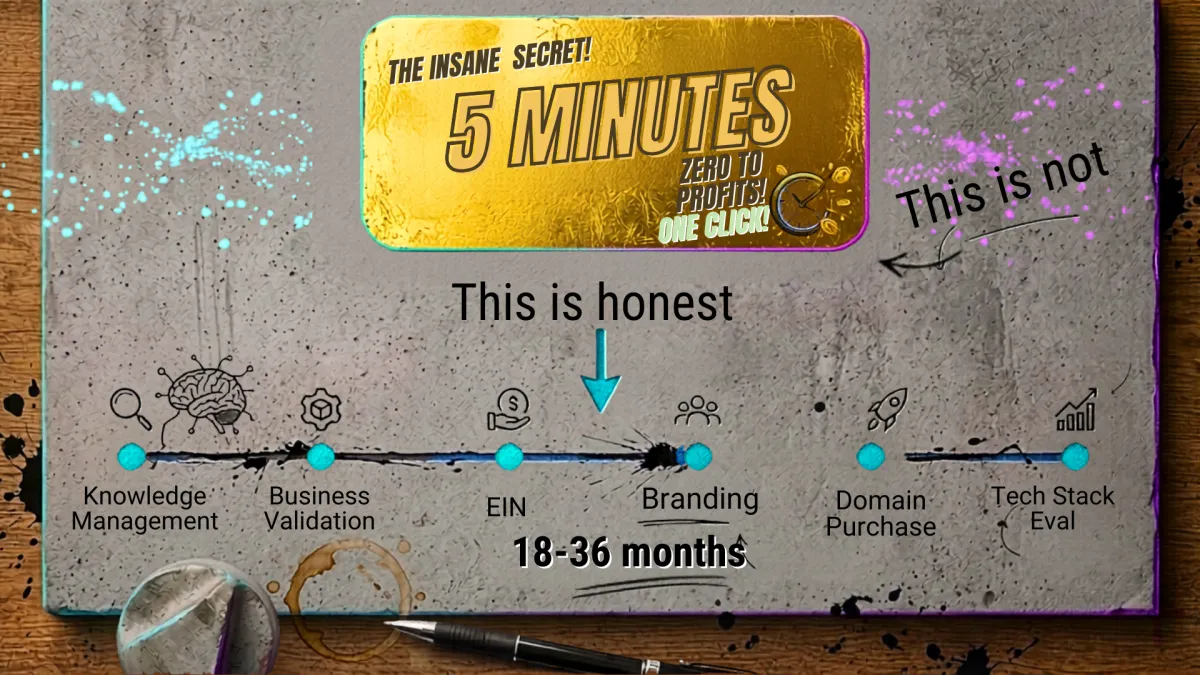
Here's what the gurus won't say: Real businesses take 18–36 months and ~130 decisions to become operational.
The solopreneurs who win now aren't the fastest clickers—they're the ones with a plan.
130 startup activities and decisions distilled into the Solopreneur Launchpad Hub
We ruthlessly pruned the advanced and tangential decisions from Panel Study of Entrepreneurial Dynamics (PSED) to a core of 13 high leverage business actions.
Each core business action includes:
✅ Definition of Done Heuristic (so you know when you're ACTUALLY finished)
✅ Planning Poker self-assessment (estimate YOUR time commitments, not someone else's)
✅ Decision frameworks (3 questions that prevent analysis paralysis)
✅ "What's in scope" boundaries (stops scope creep dead)
✅ Templates and tools (contracts, financial models, and a Google Workspace/Gemini Hub setup)
✅ "Hire Smart" sections (when to delegate, what to pay, exact job posts)
✅ Red flag warnings (signs you're unraveling—with recovery steps)
Then We added 10 Foundational Solopreneur Bonuses
What's Inside?
Delivered inside a GoHighLevel Community (you'll see it labeled as 'Courses' in the platform—that's just GHL's structure).
Each module is a stride toward completing your business infrastructure, containing decision frameworks, action items, and templates.
The Foundation (Start Here)
☐ Module 0 to 0.9 (Organization and Planning Tools ~ Bonus Setup)
☐ Module 1: LLC Formation (or sole prop decision)
☐ Module 2: EIN Application
The Money & Legal Infrastructure (After Viability Check)
☐ Module 3: Business Bank + Bookkeeping
☐ Module 4: Contract Templates
☐ Module 5: Domain + Email
☐ Module 6: Business Insurance
☐ Module 7: Permits & Licenses
The Brand & Strategy (Polish & Plan)
☐ Module 8: Branding & Visual Identity
☐ Module 9: Advanced Financial Planning (optional—skip if bootstrapping)
☐ Module 10: Operating Agreement
☐ Module 11: IP Protection (optional—skip until $10k revenue)
☐ Module 12: Business Plan Lite + Phase 2 Readiness Checklist
The Technical Bridge (Final Phase 1 Setup)
☐ Module 13: DNS + Email Authentication + Domain Connection
Phase 2 Preparation
☐ Module 14: Choose Your SaaS Platform + Core Loop Test
☐ Module 15: AI Service Delivery Foundations (optional—if selling AI)
When you complete Module 13: Phase 1 is done. You're ready to test and develop your Tech Stack.
When you complete Module 14: You've chosen your platform and are ready to test the core product loop, aka a Minimum Viable System, to achieve business value.
What happens next: You launch. Phase 2 begins. You're no longer "setting up"—you're running a business.
Who Is This For?
Module 0 ~ Knowledge Management
We recommend using Google Workspace, Gemini, Gems, and Notebook LM to manage your business brian.
This is what we use. We will show you how to set up your business brain using these tools.
AND/OR
If you don't want to use Google Workspace, we provide a knowledge management folder template to create in the data drive of your choice.
Why this matters?
Humans are terrible at knowledge management,and business requires managing lots of Set-It-and-Forget-It tasks and remembering where they are stored.
Having a knowledge management system is essential to creating a real business workflow.
Module 0.1 ~ Maker Time vs Manager Time
Building a business requires an enormous amount of creative time. Even if you use templates, snapshots, and someone else's business plan, you still need to make your own version.
Creating products and managing the business require different types of time commitments: Manager or Maker.
Knowing which is which will help save your sanity.
Module 0.2 ~ Focus Blocks | The Brain Science Behind why your calendar is a lie.
Your brain doesn't run on clock time. It runs on attention architecture—and that architecture has very specific requirements.
Module 0.3 ~ User Stories | The Foundation of Real Outcome Planning
Outcomes and tasks are not the same thing.
Your outcomes and your clients' outcomes are not the same thing.
This confusion is at the heart of business failure.
We show you how to tell the right story for the right audience, to get the right outcome.
Module 0.5 ~ The Definition of Done | “It's practically finished. All it needs is a final polish.”
Liar, Liar, Pants on fire. 90% done is not done. We will show you how to think about being DONE so you can actually finish!
Module 0.7 ~ From Stories to Action!
"As a solopreneur, I want to form an LLC so that my personal assets are protected."
Perfect. You know the outcome. You know who it's for (you). You know why it matters (asset protection).
But how long will this actually take? We will show you exactly how to figure this out.
Module 0.8 ~ Solopreneur Doggy Planning Poker
The root cause of all planning failures is that humans suck at estimating time.
But humans are exceptionally good at estimating size.
We will show you how to translate time into size and size into effort. And we will do it with five dogs.
Module 0.9 ~ The Dog Log
If you can’t track it, you can’t measure it. If you can’t measure it, you can’t ever know if you did it well. The Dog Log is your (very simple) tracking system for the effort you make and the outcomes you achieve.
Module 1.0 ~ Business Viability Check
A good idea is not a good business.
Say it with us: A good idea is not a good business. How can you tell if your good idea is a good business? We have a process to help you validate your idea BEFORE you spend a dime on infrastructure.
Module 15 ~The AI Gold Rush Reality Check
There is gold in them thar hills, yes, there really is, but . . .
(There is always a but.)
It takes a lot more than swirling water in a pan to get it out.
We’ve spent most of our professional life in IT, so hear us out when we tell you, delivering IT solutions (which AI is) to non-technical people . . . (sigh)
We will just say this: the 10K a month cash flow the YouTube Guru touted is barely minimum wage, and this assumes you know how to deliver the service. And if you corrupt a client’s business data, not even God can help you then.
If you have AI Gold Fever, this module alone will save you LOTS of money and set you on the right path for delivering real AI services that will certainly exceed 10K a month.
Who This Is For
✅ SaaS trial survivors who wasted 14 days on setup instead of learning
✅ First-time entrepreneurs stuck in "almost ready" limbo for 6+ months
✅ The overwhelmed crowd with 20 tasks 90% done, zero tasks 100% done
✅ People who just saw a business idea on YouTube and jumped into a trial too early
✅ Aspiring AI entrepreneurs (Module 15 prevents you from becoming a 2026 failure statistic)
This is NOT for:
❌ People raising VC funding (you need investor-grade plans—hire a consultant)
❌ Product companies or e-commerce (different infrastructure paths)
❌ Enterprises with 10+ employees (this is for solopreneurs and micro-teams)
❌ People who already have Phase 1 complete and just need marketing help
The SaaSy Brainformative Marketing Strategy
“Just tell the Truth”
SaaSy Brainformative does NOT give Time-Based Promises. We know that everyone wants everything yesterday with no effort.
That is not us. We deal in reality . . . the brain science reality.
We're NOT selling: "Finish in 2 weeks!" or "Launch in 30 days!"
We ARE providing decision frameworks and guides to help you navigate Foundation setup.
How long does it take? The data estimate between 19 and 36 months, but this time depends on you and your work ethic.
The Reality:
You will learn what this means and how to discover later but for now understand that some modules are Chihuahuas (the smallest focus block). Other modules are Old English Sheep Dogs (8 focus blocks spread across multiple days)
YOUR timeline depends on YOUR skill gaps.
* Do you have a legal background? Module 1 is easy.
* Do you have an IT background? Module 13 is easy.
* Are you a first-timer? Everything takes longer—and that's normal.
What we CAN promise:
If you follow the steps outlined within the modules, use the Definition of Done, and log your Planning Poker honestly, you'll finish Foundational work with zero modules pending—something 75%+ of entrepreneurs never accomplish.
Then you can focus on testing the SaaS platform that will be the cornerstone of your business.
Let's Talk...
To the first 100 Founders
The Solopreneur Launchpad is valued at $147/year recurring
(Founding 100 locked annual rate forever)
The community (the Hub) is valued at $57 paid quarterly.
But . . .
The Founding 100 will get community access for 6 months free.
P.S. Let’s talk about saving Mohhh Ney.
Module 1.0 Idea Validation
It doesn't matter what business idea you have (Real Estate, Print-on-Demand Merch, Affiliate Marketing, Clip Farming, Digital Products, Modern Dropshipping, Online Coaching), the list is as endless as the imagination.
They all have the same requirements: Profit - Infrastructure Costs - Delivery Costs = success/failure.
It is hard math.
The Math Most Entrepreneurs Skip
Your break-even is 15 clients/month, but you can only acquire and onboard 4.
Your pricing is 50% too low.
Your original target customer can't afford your service because your avatar is wrong.
Your revenue model is backwards (you're doing one-time projects when recurring would work better)
Now you have two choices:
1. Pivot (change pricing, target customer, model)—but you already spent thousands on contracts and a website with the old positioning.
2. Keep going anyway—and join the 50% of PSED entrepreneurs who never reach viability
Total cost?
It’s hard to calculate two years of operational and opportunity costs, but from our experience, this number is north of $75,000.
What Module 1.0 Costs You
Solopreneur Launchpad Hub Founder access is $147.00 for six months. (Hub access continues @ $57 Quarterly)
Open Router funded for $30.00. (It took us 6 months to get through our original funding.)
Paid version of Grok $30m (recommended) and Google Workspace ~$35m (Gemini, Gems, NotebooLM HIGHLY recommended) ChatGPT (Has its strengths but meehh, you can get access to this LLM through Open Router for pennies on the token)
(And yes, we know there are free versions. Don’t be a cheap skate. Use the pro-grade tools for a pro-grade business.)
Opportunity costs? Between 10 and 30 focus blocks, or roughly 75 to 225 hours.
(depending on your AI learning curve)
Module 1.0 Shows You how to ask AI the right questions.
AI’s ability to do real, in-depth market research, complete with an avatar and a corresponding money model, is unmatched.
Grok is tied into all trending data on X. Claude is exceptional at translating raw data into operational costs, marketing tools, and business strategy.
And most importantly, when you ask the LLM for the brutal truth about your idea, it will tell you.
Module 1 is NOT about building a business plan. You're not going to a bank for funding.
Module 1 is about you wrapping your head around all the caveats and adenda that your idea requires to be profitable.
After working through module 1, you will have a clear, go/no-go choice.
The “Just Tell The Truth” Marketing Strategy
If it’s a Go, fantastic! Your good idea just became a real opportunity!
If it’s a No-Go! Fantastic. Put a picture of Colonel Sanders on your wall. Welcome to being an entrepreneur and thinking like a business person. Pivot, redesign, rethink, retry.
And then pat yourself on the back and know you saved yourself LOTS of time and money.
P.P.S. For the AI Gold Fever Crowd
First, let us be clear. We are still early in the AI adoption evolution, but the failure to adopt AI is a business death sentence.
Second, most business owners do not have the skill or the inclination to learn how to deliver AI solutions.
Third, the market is real. The opportunity is real. There is “Gold in them thar hills!”
But . . .
(There is always a but)
AI is really an Information Technology service, and delivering IT service is hard.
No, really: very hard.
Stepping back from the Royal We, for a minute, I have spent most of my professional life delivering IT services.
I started on a help desk almost 30 years ago, climbed to the Director of IT, did IT consulting, and started my own MSP twice. If you want more details, look me up on LinkedIn. (John Immel)
Delivering IT services is hard, very hard. Marketing IT services is even harder. I know because I have the metaphorical battle scars.
But . . .
(There is always a but)
If you don’t believe me, ask yourself this fundamental question: Why does the YouTube Guru, who insists they are serious about “making money,” give away thousand-dollar automations to those who will certainly become their competitors?
The answer seems obvious: the free snapshots are lead magnets for a “mastermind group” at $499 a month. Obviously, their business model is to leverage their expertise for more money.
That is fine, but that still doesn’t change the fact that they are creating competitors.
Or are they?
Operationalizing IT delivery, at scale, with enough clients to be profitable, is hard, very hard.
No, really, it's very hard.
I suspect the dirty little secret is that they (the AI YouTube Guru de jour) don’t care about competitors because they know they are no longer in the IT delivery business.
(They may have started there, but they learned what every IT service provider learns: it’s 24/7 365 work, whose clients think what you do is magic, and hold you in a mixture of awe and contempt.)
Anyway, make no mistake, being in the SaaS reselling business is still the IT delivery business.
The GoHighlevel Affiliate business model is very, very inspiring, but make no mistake, the “Multi-Level Marketing upline” model will collapse unless affiliates actually start selling their SaaS services to businesses that are NOT in the SaaS reselling business and then those same affiliates KEEP THOSE CLIENTS for more than 24 months.
(Churn rates, churn patterns, and money models do NOT lie)
Pay attention to the real business model: GHL and Skool give awards based on revenue, which is based on headcount, NOT end-user success. Make no mistake, the focus on head count (to mitigate a ~75% churn rate) is the real business model. This means your guru does not care about IT service delivery, because they are not in a customer retention business.
In Gold Rush parlance, the YouTube Guru is in the business of selling pick axes to the wannabe miners.
And a few of them (GHL and Skool) are Levi Strauss, selling denim trousers.
Who is still in business?
Module 15: The AI Gold Rush reality check.
What does it really take to start an AI business?
Unless you have all the requisite skills, a network of 5K to 10K business contacts, and the ability to start your marketing outreach within days, there is ZERO possibility that in 6 months you will be making budget.
In 6 months, you will have $4,000 minimum in sunk costs: GHL, N8N, Make.com, LLM API charges, Anthropic subscription, OpenAI, and Zapier subscriptions. And this doesn’t include the $499 monthly mastermind cost.
Don’t dare to be in the IT services business without an LLC.
Don’t dare be in the IT service business without exceptional contracts.
Do you know what a RAG system is?
An MCP server?
Can you fix N8N automation by yourself when it breaks?
Is it a good idea to give OpenClaw read/write access to achieve real autonomous AI action?
If you answered: No, No, No, and Yes, please, for the love of all that is being a Solopreneure, invest $147.00 help alleviate the fever that is addling your brain.
Don’t get it twisted. I’m not a dream crusher. But I am a hardened realist.
There is gold in “them thar hills,” but like the Miner 49’rs figured out, it takes a lot more than buying a pick ax to dig it out of a mountain.
In my never-to-be-humble opinion, Module 15, The AI Gold Rush, will save you months of your life and thousands of dollars, preventing a serious business false start. And maybe a lawsuit.
FAQ's
Why a Wait List?
We are committing to our Definition of Done. This landing page is ready to convert interested Solopreneurs. Those who join the wait list get first dibs on the Founder 100 Price.
However, the core modules are a Giant Schnauzer from shippable. And while we really do like Go High Level, getting it to play well in public requires the occasional Old English Sheep Dog of focus time.
Solopreneur Pro Tip: Ship what you can, as fast as you can.
P.S. The Definition of Done, Giant Schnauzer and Old English Sheep Dogs focus blocks are covered in Module 0.5 and 0.8.
How many Founders seats will you offer?
100.
Founders get the Launchpad Hub AND the community for $147.00 for six months. Month seven we will charge the first quarterly payment of $57 a month.
This is the lowest pricing structure the Solopreneur Launchpad Hub will ever be.
Can you tell us more about this brain science methodology?
You ask a dangerous question because we love, love, love talking about cognitive neuroscience and cognitive psychology applied to learning.
But since an FAQ cannot possibly do justice to the subject we will give you our first homework assignment.
(Your marketing department will be scandalized that we sent you off our conversion page without getting a lead but we're pretty sure you'll be back)
Here's the homework assignment: We have growing library of articles on how brain science impacts SaaS platform adoption and entrepreneurial effort.
And for you multitaskers out there here's the dirty little secret. The brain science is clear: YOU CAN'T.
What is your Refund Policy
Yes we offer refunds.
Refunds are explained in detail in our Terms of Service, but the bottom line is that if you are part of the Founding 100, you have 30 days to ask for a refund.
There are two criteria:
1. You have consumed less than 25% of the course content
2. You provide a brief explanation of why the course didn't meet your needs
After 30 days or 25% consumption (whichever comes first): No refunds available.
Questions about refunds? Email us at [email protected]
Do you have an affiliate program?
The short answer is no, even though technically everyone who has an account on Go High Level has an affiliate link. The longer answer requires more space than an FAQ. That article hasn't been written yet, but you can keep up to date on our latest musings HERE.
I could probably figure this out myself. Why should I pay $147 a year for a bunch of checklists?
Short Answer:
We object to this Launchpad Hub being called a "bunch of checklists," but if that is what you think we have described above, fantastic, that's exactly what you should do.
And here is the key source used to refine this product: The Panel Study of Entrepreneurial Dynamics (PSED). Jeff Southerland's book Scrum: The Art of Doing Twice the Work in Half the Time will introduce you to effort management. And ask your favorite LLM to do deep research on the cognitive neuroscience behind focus, attention, multitasking, and planning. It will be an exceelent reading list.
If you're self-motivated and you have the time to do it 100%, that's exactly what you should do.
Long Answer:
Yes, every piece of this is theoretically discoverable. Jeff Sutherland's book is on Amazon. Weber's Law is in any cognitive psychology textbook. The neuroscience research on task-switching and vigilance decrement is publicly available. You could, in theory, connect all the dots yourself.
Here's what that actually looks like in practice:
Month 1–2: Discovery
You read Scrum and think, "This is brilliant—but it's for teams. How do I adapt this when I'm the Product Owner, Scrum Master, and the entire dev team?" You try to figure it out. You get stuck. You move on.
Month 3–4: Experimentation
You discover Planning Poker and try to use it with the Fibonacci sequence. But the numbers are abstract and you can't translate them into your calendar. You abandon it after two weeks.
Month 5: Frustration
You read about Focus Blocks and task-switching costs. You try to protect 90-minute blocks, but you have no system for what goes in them. You're still working from a task list, so the blocks fill with reactive busywork instead of outcomes.
Month 6–7: Partial Integration
You finally connect the dots between User Stories, effort estimation, and Focus Blocks—but you're doing it in three separate tools that don't talk to each other. Your planning is split across Notion, a Google Doc, and a paper notebook. You spend 30 minutes just finding where you wrote something down.
Month 8–9: Refinement (Maybe)
If you're unusually persistent, you eventually cobble together a working system. But it's fragile. It only works when you remember to use it. And you have no idea if you're doing it "right" because you've never seen it work for anyone else.
Total cost:
* 800+ hours of reading, testing, and troubleshooting
* Dozens of false starts and abandoned experiments
* Months of suboptimal planning while you figure it out
* Opportunity cost: All the business outcomes you didn't ship while you were building your system